ACTIVITIES
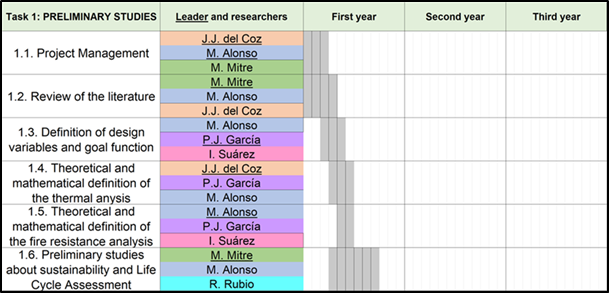
TASK 1: PRELIMINARY STUDIES
1.1. Project management
1.2. Review of the literature
1.3. Definition of design variables and goal function
1.4. Theoretical and mathematical definition of the thermal analysis
1.5. Theoretical and mathematical definition of the fire resistance analysis
1.6. Preliminary studies about sustainability and Life Cycle Assessment (LCA)
TASK 2: CHARACTERIZATION OF LWCs WITH PCM
2.1. Determination of workability of LWC with microencapsulated PCM using slump test.
2.2. Determination of density, porosity and pore structure of LWC with microencapsulate PCM.
2.3. Determination of mechanical properties of LWC with microencapsulated PCM: compression and flexural strength
2.4. Determination of the concrete quality using initial surface absorption tests (ISAT)
2.5. Determination of thermal conductivity as a function of temperature range from 0ºC to 60ºC using MTPS inside a climatic chamber
2.6. Determination of flammability of PCM and LWC with PCM using cone calorimeter method
13 de 20
2.7. Characterization of phase change process of PCM using differential scanning calorimetry tests (DSC)
2.8. Determination of latent heat and enthalpy during the phase change period of PCM using Temperature History Method tests (THM)

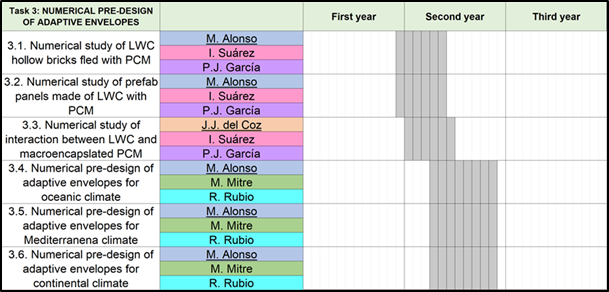
TASK 3. NUMERICAL PRE-DESIGN OF ADAPTIVE ENVELOPES
3.1. Numerical study of LWC hollow blocks filled with microencapsulated PCM
3.2. Numerical study of prefabricated panels made of LWC with microencapsulated PCM
3.3. Numerical study of the interaction between LWC and macroencapsulated PCM
3.4. Adaptive envelope pre-design for Oceanic climate
3.5. Adaptive envelope pre-design for Mediterranean climate
3.6. Adaptive envelope pre-design for Continental climate
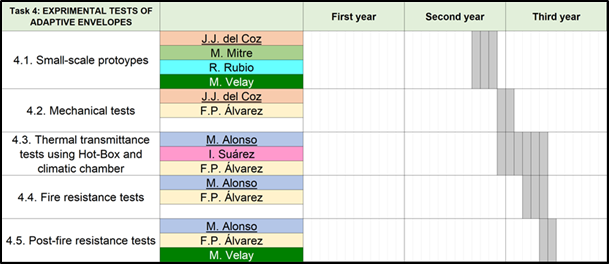
TASK 4. EXPERIMENTAL TESTS OF ADAPTIVE ENVELOPE SMALL-SCALE PROTOTYPES
4.1. Manufacturing of small-scale prototypes for each climate: Oceanic, Mediterranean and Continental
4.2. Characterization of mechanical properties of small-scale prototypes of adaptive envelopes
4.3. Determination of thermal transmittance of small-scale prototypes using Hot-Box and climatic chamber
4.4. Determination of fire resistance performance of small-scale prototypes using ISO-834 curve
4.5. Determination of post-fire resistance of small-scale prototypes
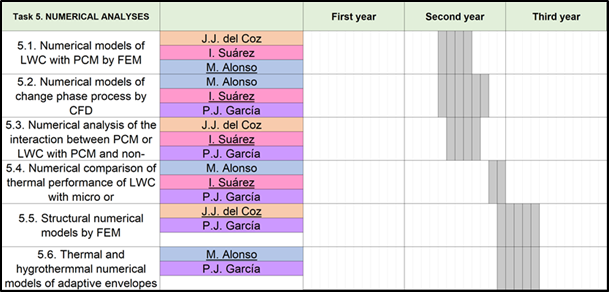
TASK 5. ADAPTIVE ENVELOPE ANALYSES USING ADVANCED NUMERICAL MODELS
5.1. Development of numerical model of LWC with microencapsulated PCM material
5.2. Development of numerical models of melting and solidification processes of macroencapsulated PCM and LWC with microencapsulated PCM using CFD
5.3. Development of numerical models of the thermal interaction between LWC with PCM or macroencapsulated PCM and air cavities
5.4. Numerical comparison of the thermal performance of LWC with micro or macroencapsulated PCM: hollow blocks filled; prefabricated panels or macroencapsulated PCM
5.5. Development of structural analyses of adaptive envelopes using FEM
5.6. Development of thermal and hygrothermal numerical models of adaptive envelopes using FEM
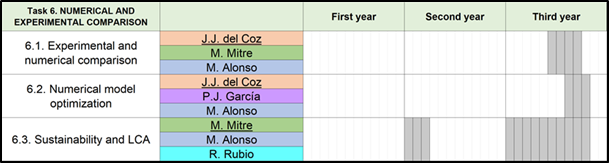
TASK 6. EXPERIMENTAL AND NUMERICAL COMPARISON
6.1. Experimental and numerical comparison
6.2. Numerical model optimization by statistical methods
6.3. Sustainability and Life Cycle Assessment (LCA) of adaptive envelopes
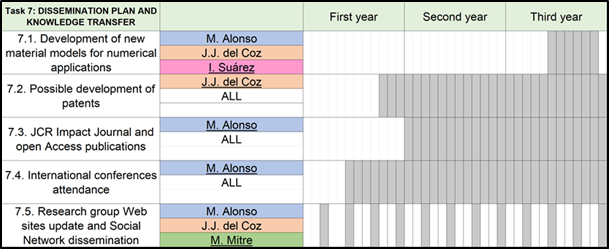
TASK 7. DISSEMINATION PLAN AND KNOWLEDGE TRANSFER
7.1. Development of new material models for numerical applications
7.2. Possible development of patents
7.3. JCR Impact Journal and open Access publications
7.4. International conferences attendance
7.5. Research group Web sites update and Social Network dissemination